Odor gone — not just covered up.
Persistent odors come from a source, not the air. Our team removes that source and neutralizes what's left at the molecular level — so smoke, mold, and other stubborn smells are actually eliminated, not masked with fragrance.
Why professional odor removal matters.
A lingering odor is a symptom, not the problem. Smells from smoke, water, mold, or sewage come from a physical source — residue soaked into drywall and framing, moisture trapped in materials, or particles circulating through your HVAC system. Spraying fragrance over it only covers the smell until it returns.
Smoke odor is especially stubborn: the residue is acidic and penetrates porous materials, which is why a room can smell of smoke long after it looks clean. Musty odors point to moisture or mold that's still active. In both cases, the fix starts with finding and removing the source — not masking it.
From there, our certified team uses the right tool for the job: HEPA and activated-carbon air scrubbing, thermal fogging to reach where odors settled, and hydroxyl or ozone treatment to neutralize odor molecules — ozone only in unoccupied spaces, hydroxyl generators for occupied areas. We finish by treating the HVAC system and sealing surfaces that hold odor, so the result is air that's genuinely clean.
Our proven odor removal process.
Lasting odor removal isn't one product — it's a sequence that addresses the source, the air, and the surfaces that hold the smell.
Inspection & Source Identification
We trace the odor to its actual source — residue, trapped moisture, contaminated materials, or ductwork — because you can't deodorize over an active source.
Source Removal & Cleaning
We remove odor-bearing materials and deep-clean affected surfaces to eliminate the bulk of the smell at its origin.
Air Scrubbing
HEPA filtration with activated carbon captures airborne particles and odor compounds throughout the affected space.
Molecular Odor Neutralization
Thermal fogging, hydroxyl generators, or ozone treatment neutralize odor molecules at their source — matched to whether the space is occupied or vacant.
HVAC & Surface Sealing
We treat the HVAC system so odors don't recirculate, and seal porous surfaces that can still hold smell after cleaning.
Final Verification
We confirm the odor is genuinely gone — not temporarily masked — before we consider the job complete.
Stubborn odors, professionally removed.
If a smell keeps coming back no matter how much you clean, the source is still there. Here's how we find it and remove it for good.
- Smoke & Fire Odor: Acidic residue penetrates porous materials — we clean, thermal-fog, and seal to remove it, not cover it.
- Water, Mold & Musty Odor: Musty smells signal moisture or mold; we address the underlying source as we deodorize.
- Sewage & Biohazard Odor: After cleanup of a contamination event, we sanitize and neutralize the odors left behind.
- Source Removal First: We remove odor-bearing materials rather than spraying over them, so the smell doesn't return.
- HEPA + Activated Carbon Filtration: Industrial air scrubbing pulls odor compounds out of the air during treatment.
- Molecular Neutralization: Thermal fogging and hydroxyl or ozone treatment, matched to occupied vs. vacant spaces for safety.
- HVAC Treatment & Verification: We treat ductwork so odors don't recirculate, then confirm the result before we finish.
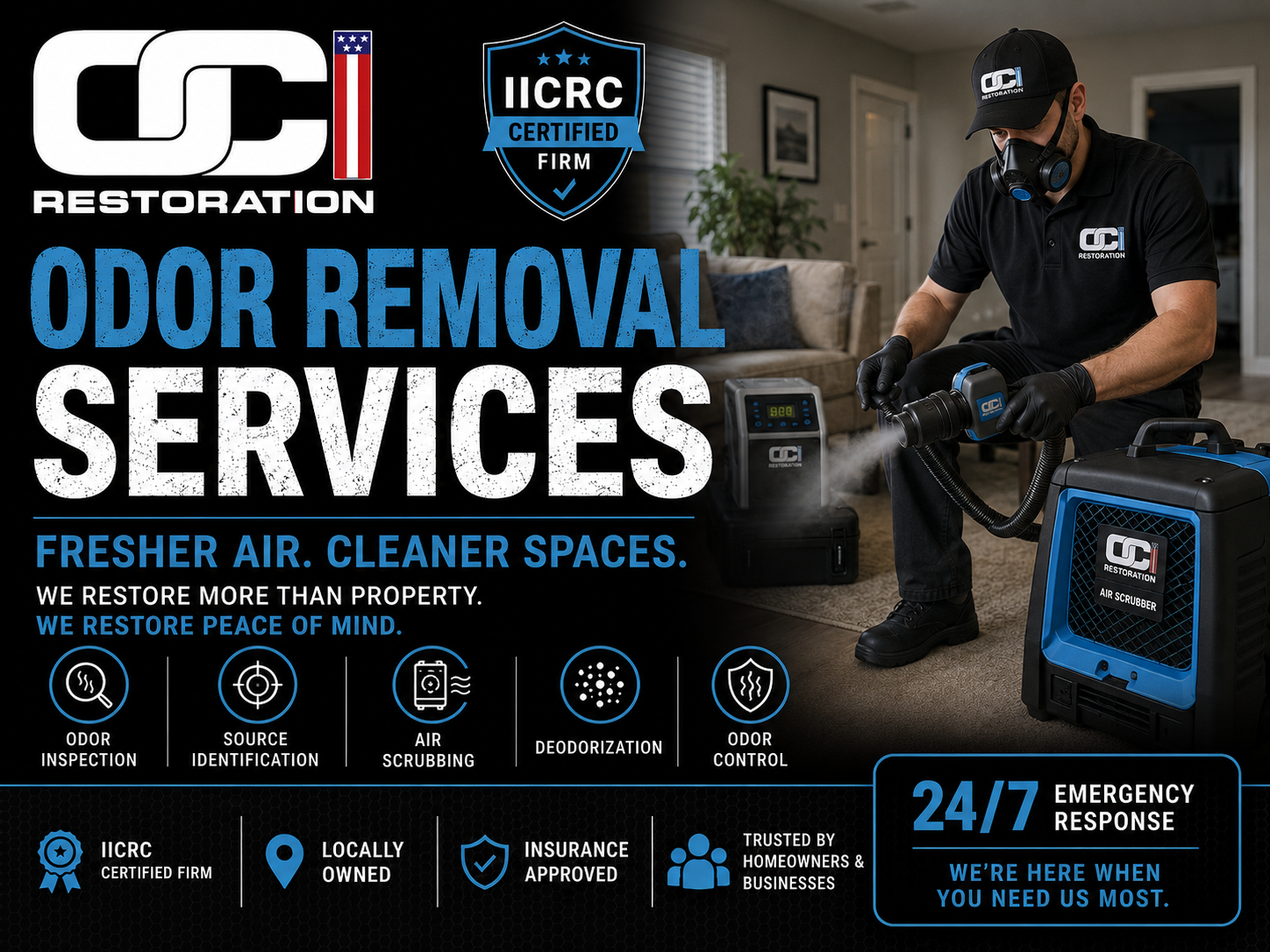
Odor removal
across the Triangle.
The Triangle's humidity makes musty, lingering odors a common problem — and smoke or water events leave smells that don't clear on their own. OCI Restoration tracks down the source and removes it for homes and businesses across the region.
We serve Wake, Durham, and Orange counties — from downtown Raleigh and the RTP corridor to Cary, Apex, Holly Springs, Wake Forest, Garner, Knightdale, Morrisville, and Fuquay-Varina.
View All Service Areas →We cleared
the air.
OCI does fantastic work. They were at my house on short notice with a team of professionals. They settled everything with our insurance adjuster and made what could have been a difficult situation very easy for me and my family.
Add a recent odor removal review from your Google profile here.
Add a recent odor removal review from your Google profile here.
Frequently asked questions.
Don't see your question? Call us anytime — real people, 24/7.
Ready to breathe easy?
Veteran-owned, IICRC-certified odor removal — source-level treatment that eliminates odors instead of masking them.