
Fire and Smoke Damage Insurance Claims in North Carolina
Fire claims are among the largest and most document-heavy claims a homeowner will file. Here's how they usually unfold, and where smoke and soot fit in.
Fire is a core covered peril in North Carolina homeowners policies, and the fire portion of property policies here is shaped by the state's standard fire policy provisions in N.C. Gen. Stat. § 58-44-16. A fire claim typically covers the structure, smoke and soot damage, contents, and additional living expenses if you can't stay home, all subject to your policy's limits and terms. Expect your carrier to ask for a sworn proof of loss and a detailed contents inventory. Smoke and soot damage often reaches well beyond the burned area, so documenting the whole home matters.
North Carolina's standard fire policy
North Carolina sets out standard fire insurance policy provisions in state law (N.C. Gen. Stat. § 58-44-16). Among other things, those provisions address:
- Proof of loss. A signed, sworn proof of loss within 60 days after the loss, unless the insurer extends that time in writing.
- Appraisal. A process for resolving disagreements about the amount of a loss.
- Your duties after a loss, including protecting the property from further damage and providing an inventory of damaged property.
Your homeowners policy will have its own wording on top of these provisions. Read the "duties after loss" and "loss settlement" sections, and the letters your carrier sends, for the exact requirements and deadlines that apply to you.
What a fire claim usually includes
The structure
- Burned and heat-damaged framing, drywall, roofing
- Smoke and soot cleaning throughout the home
- Water damage from firefighting
- Odor removal
- Board-up and securing the property
Contents and living expenses
- Cleaning or replacing furniture, clothing, electronics
- Pack-out, cleaning, and storage of salvageable items
- Additional living expenses while the home is repaired
- Debris removal
Coverage for each depends on your policy's limits, deductibles, and terms. The adjuster determines what's covered.
Smoke and soot travel farther than you think
Smoke moves through the whole house: through the HVAC system, into closets and cabinets, behind outlet covers, and into insulation. Rooms that look untouched can still carry soot residue and odor. That's why the documentation should cover the entire home, not only the room where the fire started.
Don't try to wipe soot off walls or upholstery yourself. Some soot smears and sets into surfaces when cleaned the wrong way, which can turn a cleanable item into a replacement. Photograph it, then leave it for professional cleaning.
Water from firefighting is part of the loss too. Wet drywall, flooring, and insulation need drying, and that should start promptly.
The contents inventory
The contents inventory is often the most time-consuming part of a fire claim. Carriers typically want each damaged item listed with a description, age, and estimated value. A few things make it easier:
- Work room by room, and photograph items before they're moved or cleaned.
- Check phone photos, online order history, and receipts to recall items and their age.
- Ask about a pack-out: salvageable items are inventoried, removed, cleaned, and stored while the structure is repaired.
- Separate items that can be cleaned from those that can't. Your adjuster will want to know which is which.
Payments, depreciation, and your lender
As with other property claims, replacement cost policies often pay actual cash value first and release withheld depreciation after items are replaced or repairs are completed. On a large fire claim, your mortgage lender is often named on structure payments and may release funds in stages as work progresses. Call your servicer early to learn their process.
How OCI works a fire and smoke loss
From securing the property to rebuilding it, under one NC general contractor license.
- Secure the propertyBoard-up and tarping to protect the home from weather and entry.
- Document everythingPhotos of every room, including smoke-affected areas away from the fire.
- Water removal and dryingFirefighting water is extracted and materials are dried.
- Pack-out and contentsSalvageable contents are inventoried, cleaned, and stored.
- Soot and odorSurfaces are cleaned and odor is treated throughout the structure.
- RebuildReconstruction from framing to finishes, backed by Onofrio Construction.
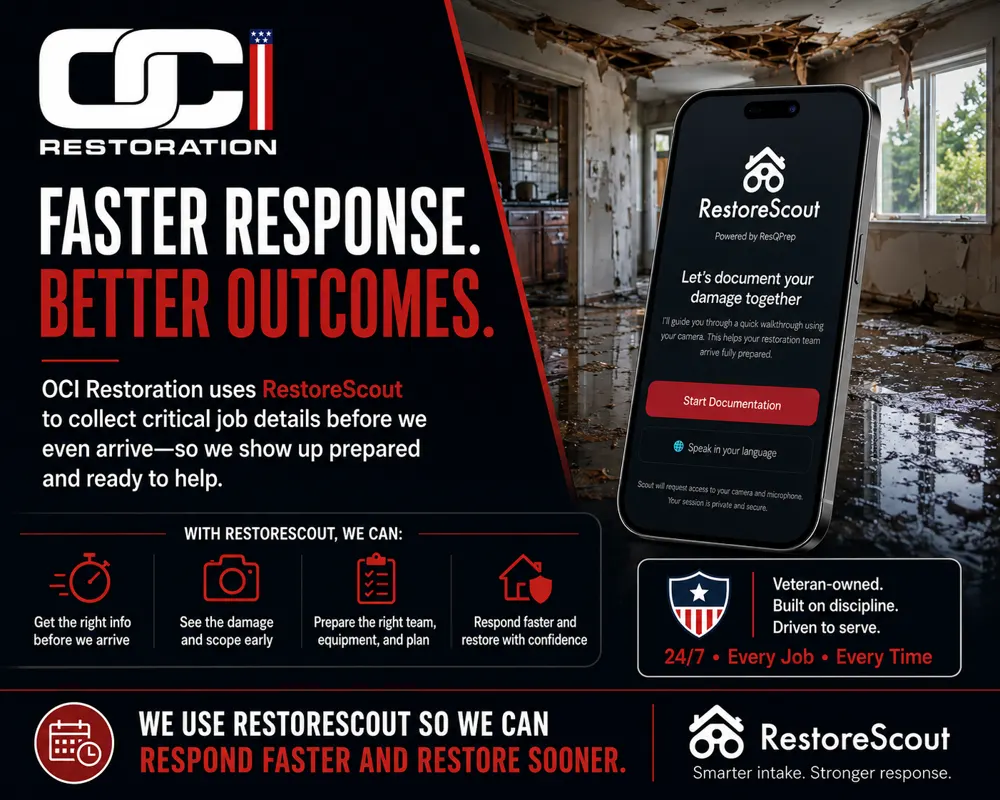
Document the damage before we arrive.
After a fire, RestoreScout helps you photograph and describe each room, including the smoke-affected areas that are easy to overlook, so your carrier sees the full extent of the loss.
What you capture goes straight to our team, so the crew arrives already knowing the scope, the access, and what equipment to bring — and your insurance file starts building from the first photo instead of the first visit.
- Takes a few minutes, whenever you're ready
- Nothing to download — it runs in your browser
- Available in your language
- Your session is private
Scout will ask for access to your camera and microphone. If you'd rather not use it, calling gets a team moving just as fast.
Frequently asked questions
Don't see your question? Call us anytime — real people, 24/7.
Is smoke damage covered by homeowners insurance in North Carolina?
Smoke damage from a fire is typically part of a fire claim under a homeowners policy. Smoke from a fire next door or nearby may also be a covered loss under your own policy. Your adjuster determines coverage under your specific policy.
How long do I have to file a proof of loss after a fire in NC?
North Carolina's standard fire policy provisions call for a sworn proof of loss within 60 days after the loss unless the insurer extends that time in writing. Check your policy and your carrier's letters for the requirement that applies to you.
Should I clean soot off the walls myself?
No. Some soot smears and sets into surfaces when cleaned improperly. Photograph it and leave it for professional cleaning so it doesn't turn a cleanable surface into a replacement.
Will insurance pay for somewhere to live after a fire?
Many homeowners policies include additional living expenses if a covered fire makes your home unlivable. Ask your carrier in your first call, and keep every receipt.
What is a pack-out?
A pack-out is when salvageable belongings are inventoried, removed from the home, cleaned, and stored while the structure is repaired. It protects items from further damage and creates a record for your contents claim.
Can OCI Restoration rebuild after the fire, not just clean up?
Yes. OCI Restoration holds NC General Contractor License L.67743 and is backed by Onofrio Construction, so mitigation, cleaning, and reconstruction can be handled by one team.
Related claim guides and services
Sources
After a fire, we secure, clean, and rebuild.
24/7 emergency mitigation and full restoration across the Triangle from our Raleigh office.
Important: OCI Restoration is a licensed restoration contractor, not a public adjuster, insurance agent, or insurance advisor. This page is general information about how property claims commonly work in North Carolina. Your policy language and your insurance carrier determine coverage. For questions about your specific policy, talk to your agent, your carrier, or a licensed public adjuster or attorney. The N.C. Department of Insurance Consumer Services Division can be reached at 855-408-1212.