
The Restoration Claim Process, Step by Step
What actually happens between the moment you find damage and the day the last check clears, and where homeowners in North Carolina most often get stuck.
A North Carolina property damage claim usually moves through eight stages: report, emergency mitigation, adjuster assignment, inspection, scope and estimate, coverage decision, restoration, and payment. Mitigation runs alongside the first few stages rather than waiting for them. Most delays come from missing documentation, hidden damage found mid-job, and depreciation that isn't released until repairs are complete. Knowing what each stage needs from you keeps the claim moving.
The eight stages of a property claim
Stages overlap in real life. Emergency mitigation in particular starts right away, long before the scope is agreed.
- Report the lossCall your carrier or agent and get a claim number. Note the date and who you spoke with.
- Emergency mitigationStop the damage from spreading: water extraction, drying, board-up, tarping.
- AssignmentThe carrier assigns an adjuster, sometimes a field adjuster and sometimes a desk adjuster.
- InspectionThe adjuster reviews the damage in person or from photos and documentation.
- Scope and estimateThe repair scope is written and priced, usually in estimating software.
- Coverage decisionThe carrier confirms what it will and won't pay, in writing.
- RestorationRepairs and rebuild, plus supplements if hidden damage is found.
- PaymentPayments are issued, often in stages, with any recoverable depreciation at the end.
Stage by stage: what each one needs from you
1. Report the loss
Report as soon as you reasonably can. Write down the claim number, the date and time, and the name of anyone you speak with. Start a simple claim journal now. It is the single most useful document you will have if questions come up later.
2. Emergency mitigation
Your policy generally expects you to protect the property from further damage. You don't need to wait for the adjuster to start extraction, drying, or board-up. Photograph conditions first, keep every receipt, and let your carrier know mitigation is underway. Mitigation is usually billed and reviewed separately from the rebuild.
3. Assignment
Your carrier assigns an adjuster. After large storms, assignment can take longer because adjusters are handling many claims at once. If you haven't heard anything in a reasonable time, call your carrier with your claim number and ask who is assigned.
4. Inspection
Be present for the inspection if you can, and have your photos, receipts, and mitigation records ready. Point out everything you know about, including areas you suspect are damaged but can't see.
5. Scope and estimate
The adjuster writes a scope of the damage and prices it. Your contractor writes one too. The two are often close but rarely identical. Differences in line items, quantities, or pricing are normal and are worked out with documentation: photos, measurements, and moisture readings.
6. Coverage decision
The carrier confirms coverage in writing. North Carolina's Department of Insurance rules require that a denial of a claim, or part of a claim, be given in writing with the reason. If something is denied, ask for the specific policy language it relies on.
7. Restoration and supplements
Once walls are opened, crews sometimes find damage that couldn't be seen during inspection, such as wet framing, damaged subfloor, or water that traveled farther than expected. When that happens, it is documented with photos and readings and submitted to your adjuster as a supplement for review. Work on hidden damage should be documented before it is covered back up.
8. Payment, depreciation, and your lender
Many replacement cost policies pay the actual cash value first, which is the cost minus depreciation, then release the withheld depreciation after repairs are completed and documented. Keep your final invoices and completion photos so you can claim it.
If you have a mortgage, your lender is often named on claim checks. Lenders typically have their own process for endorsing and releasing funds for repairs, so contact your mortgage servicer early to learn what they require.
If you and your carrier disagree
- Ask for the reason in writing, including the policy language relied on.
- Provide additional documentation. Many disagreements are resolved with better photos, measurements, or readings.
- Appraisal. Many property policies include an appraisal clause for disagreements about the amount of the loss (not whether it's covered). Your policy describes how it works.
- NCDOI Consumer Services at 855-408-1212 can help with questions about how your claim is being handled.
- A licensed public adjuster or attorney can represent you. In North Carolina, anyone other than your attorney who negotiates a claim for you in exchange for pay must be licensed as a public adjuster.
North Carolina law (N.C. Gen. Stat. § 58-63-15(11)) lists unfair claim settlement practices insurers may not engage in, such as failing to acknowledge and act reasonably promptly on communications about a claim.
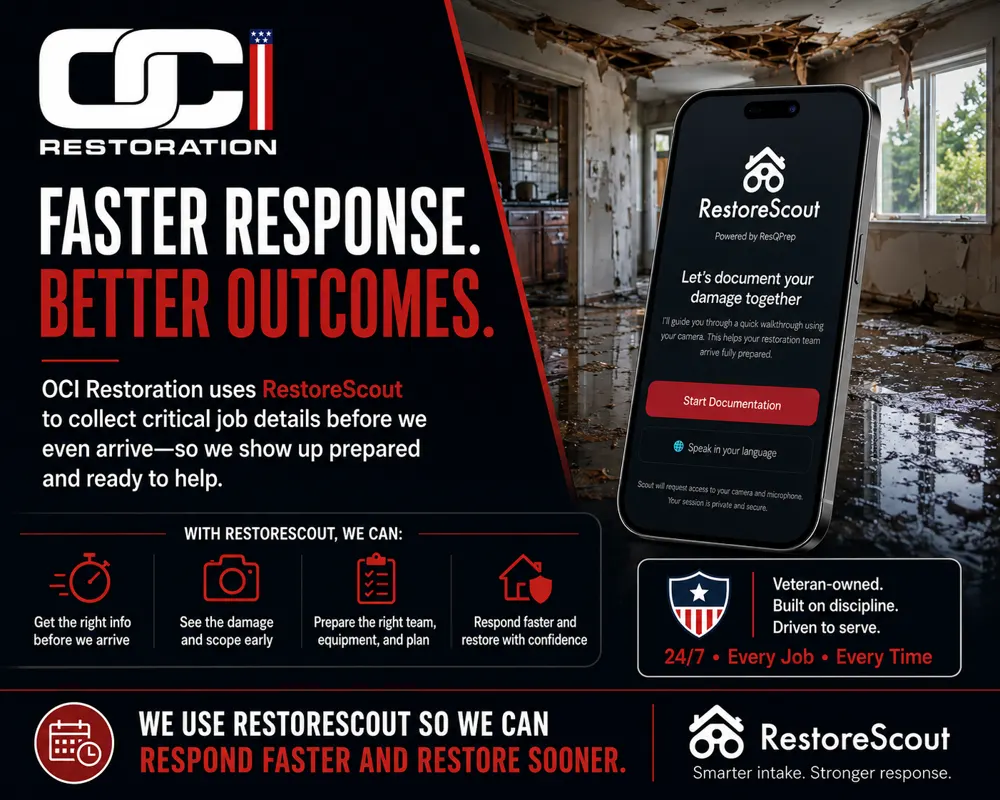
Document the damage before we arrive.
Most claim delays trace back to missing records. RestoreScout starts your documentation on day one with timestamped photos and a description of the damage, organized the way carriers ask for it.
What you capture goes straight to our team, so the crew arrives already knowing the scope, the access, and what equipment to bring — and your insurance file starts building from the first photo instead of the first visit.
- Takes a few minutes, whenever you're ready
- Nothing to download — it runs in your browser
- Available in your language
- Your session is private
Scout will ask for access to your camera and microphone. If you'd rather not use it, calling gets a team moving just as fast.
Frequently asked questions
Don't see your question? Call us anytime — real people, 24/7.
How long does a restoration insurance claim take in North Carolina?
Emergency mitigation usually runs days. The full claim, including scope agreement, reconstruction, and final depreciation payment, can take weeks to months depending on the size of the loss, carrier workload, and whether hidden damage turns up.
What is a supplement?
A supplement is a documented request to add work to the approved scope, usually because hidden damage was found after walls or floors were opened. It goes to your adjuster for review with photos and measurements.
Why did my first check come in lower than the estimate?
On many replacement cost policies, the first payment is actual cash value: the repair cost minus depreciation and your deductible. The withheld depreciation is typically released after repairs are completed and documented.
Why is my mortgage company on my insurance check?
Lenders are often named on property claim checks because they have a financial interest in the home. Contact your mortgage servicer to learn their process for endorsing checks and releasing repair funds.
Does OCI Restoration negotiate with my insurance company?
No. We document the damage, write a repair scope, and provide records to your adjuster at your request. Negotiating a claim on your behalf requires a public adjuster license in North Carolina.
Related claim guides and services
Sources
Starting a claim? Start the records today.
24/7 emergency mitigation and full restoration across the Triangle from our Raleigh office.
Important: OCI Restoration is a licensed restoration contractor, not a public adjuster, insurance agent, or insurance advisor. This page is general information about how property claims commonly work in North Carolina. Your policy language and your insurance carrier determine coverage. For questions about your specific policy, talk to your agent, your carrier, or a licensed public adjuster or attorney. The N.C. Department of Insurance Consumer Services Division can be reached at 855-408-1212.