
Does Homeowners Insurance Cover Water Damage in North Carolina?
It depends on where the water came from and how long it was happening. Here's how carriers usually sort water losses, and what helps a legitimate claim move.
Most standard homeowners policies in North Carolina cover water damage that is sudden and accidental, such as a burst supply line, a failed water heater, or an appliance hose that lets go. They generally do not cover damage from a slow leak that went on for weeks, from groundwater or surface flooding, or from sewer and drain backup unless you added that coverage. Your carrier's adjuster decides coverage under your specific policy. What you control is how fast the water is stopped and dried, and how well the damage is documented.
How carriers sort a water loss: sudden or gradual
Almost every water claim starts with the same question from the adjuster: what was the source, and when did it start? The answer usually decides which side of the coverage line the loss falls on.
Usually treated as covered
- A frozen or burst pipe inside the home
- A cracked supply line to a toilet, sink, or ice maker
- A washing machine or dishwasher hose failure
- A water heater that ruptures
- An HVAC drain line or pan that suddenly overflows
Usually excluded or limited
- A slow drip under a sink that rotted the cabinet floor over months
- Repeated seepage around a shower or tub
- Groundwater or rising surface water entering the home (flood)
- Water backing up through a sewer or floor drain, unless endorsed
- Damage made worse because the water was left sitting
These are general patterns, not guarantees. Policy wording differs between carriers and between policy forms, and the adjuster applies your policy to the facts of your loss.
Flood is a separate policy
Standard homeowners policies exclude flood, meaning water that rises from outside and enters the home, such as stormwater or an overflowing creek. Flood coverage is sold separately, most often through the National Flood Insurance Program. FEMA notes that a new NFIP policy typically has a 30-day waiting period before it takes effect, so it cannot be bought after a storm is already on the way.
That distinction matters in the Triangle after heavy rain. Water coming through a failed roof or window during a storm may be handled under your homeowners policy; water flowing in at ground level usually is not. The adjuster will look closely at how the water got in.
Sewer and drain backup
Many homeowners policies exclude water that backs up through sewers or drains unless you purchased a water backup endorsement. If you are not sure whether you have it, your declarations page or your agent can tell you. Sewage losses also need specific handling because the water is contaminated. That changes what can be dried and saved and what must be removed.
The leak versus the damage it caused
Many policies treat the failed part and the resulting damage differently. Water damage to floors, walls, and contents may be covered, while the worn-out part that failed, such as an old supply line or a corroded fitting, may not be. Some policies also address the cost of opening a wall or floor to reach the leak. Ask your adjuster how your policy handles both pieces so there are no surprises later.
What your adjuster will look for
- Cause and source. Photos of the failed part, and the part itself if it was removed. Don't throw it away.
- Timing. When you discovered the water and when you reported it.
- Signs of long-term water. Staining, rot, or mold growth that suggests the problem existed before the reported event.
- Mitigation. Proof that reasonable steps were taken to stop the damage from spreading, with dates.
- Drying records. Moisture readings, equipment placed, and readings over the following days showing materials reached dry standard.
OCI Restoration follows the IICRC S500 standard for water damage restoration. It calls for exactly the moisture mapping and daily monitoring records that adjusters ask to see.
What OCI does on a water claim
Each step produces records you can hand to your carrier.
- Respond and photographOriginal conditions are photographed before anything is moved or removed.
- Find the sourceWe confirm the water is stopped and document what failed.
- Map the moistureMeters and thermal imaging show how far water traveled into walls, floors, and cabinets.
- Extract and dryWater removal and drying equipment, with placement recorded.
- Monitor dailyReadings are logged until materials reach dry standard.
- Scope the repairsAn itemized scope your adjuster can review, then reconstruction under our NC general contractor license.
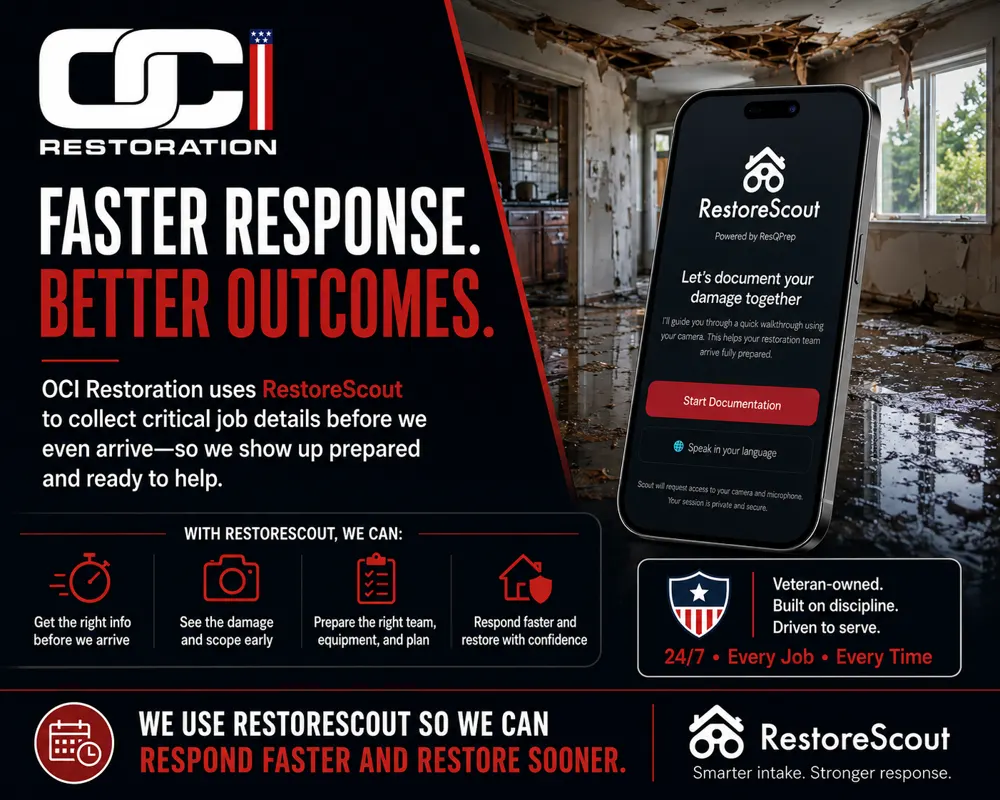
Document the damage before we arrive.
RestoreScout walks you through photographing and describing water damage from your phone, room by room, so you have a timestamped record from the first hour. Your report goes straight to our team.
What you capture goes straight to our team, so the crew arrives already knowing the scope, the access, and what equipment to bring — and your insurance file starts building from the first photo instead of the first visit.
- Takes a few minutes, whenever you're ready
- Nothing to download — it runs in your browser
- Available in your language
- Your session is private
Scout will ask for access to your camera and microphone. If you'd rather not use it, calling gets a team moving just as fast.
Frequently asked questions
Don't see your question? Call us anytime — real people, 24/7.
Is a burst pipe covered by homeowners insurance in North Carolina?
A pipe that suddenly bursts inside the home is the kind of loss most standard homeowners policies are written to cover. Coverage can be limited if the home was vacant or unheated for a long period, depending on your policy. Your adjuster makes the final call.
Does homeowners insurance cover a slow leak?
Usually not. Damage that develops over weeks or months from a slow leak or repeated seepage is typically excluded as gradual damage or wear. Some policies cover hidden leaks under specific conditions, so check your policy wording or ask your agent.
Is water from heavy rain covered?
It depends on how the water entered. Rain that comes through storm damage to the roof or windows may be handled under a homeowners policy. Surface water that rises and flows into the home is generally considered flood, which requires a separate flood policy.
Should I keep the part that failed?
Yes. Keep the broken supply line, fitting, or valve, and photograph it where it failed. Your carrier may want to inspect it, and it helps establish a sudden cause.
Can I start drying before the adjuster comes out?
Generally yes. Policies typically expect you to take reasonable steps to prevent further damage. Photograph everything first, keep receipts, and let your carrier know mitigation has started.
Will OCI Restoration talk to my adjuster?
We can share our photos, moisture readings, drying logs, and scope with your adjuster at your request. We do not negotiate your claim or interpret your policy; that work requires a licensed public adjuster or attorney.
Related claim guides and services
Sources
Water in your home right now? We answer 24/7.
24/7 emergency mitigation and full restoration across the Triangle from our Raleigh office.
Important: OCI Restoration is a licensed restoration contractor, not a public adjuster, insurance agent, or insurance advisor. This page is general information about how property claims commonly work in North Carolina. Your policy language and your insurance carrier determine coverage. For questions about your specific policy, talk to your agent, your carrier, or a licensed public adjuster or attorney. The N.C. Department of Insurance Consumer Services Division can be reached at 855-408-1212.