
Does Insurance Cover Mold Remediation in North Carolina?
Mold coverage usually follows the water that caused it. If the water event was covered, mold that resulted from it may be. If the moisture was long-term, it usually isn't.
Homeowners insurance in North Carolina generally does not pay for mold on its own. Coverage, when it exists, usually depends on the cause: mold that results from a sudden, covered water loss (a burst pipe, a failed supply line) is treated very differently from mold caused by long-term humidity, a slow leak, or deferred maintenance, which policies commonly exclude. Many policies also have their own mold section that limits or restricts this coverage. The fastest way to protect a potential mold claim is to report and dry the original water damage quickly.
The cause of the moisture decides most mold claims
Mold needs moisture to grow. When an adjuster looks at a mold claim, the real question is about the water: what caused it, and was that cause covered?
More likely to be considered
- Mold that follows a sudden pipe burst or appliance failure
- Mold inside a wall cavity after a covered leak that was reported promptly
- Mold that developed during the drying of a covered water loss
Commonly excluded
- Mold from ongoing high humidity or poor ventilation
- Mold from a slow leak that went on for months
- Mold in crawlspaces from long-term ground moisture
- Mold that grew because a known leak was not repaired
North Carolina's climate makes this distinction common. Humid summers and vented crawlspaces create conditions for mold growth that have nothing to do with a single event, and policies are generally written to exclude that kind of gradual condition.
Read the mold section of your policy
Many homeowners policies address mold directly, often under language about "fungi," "wet or dry rot," or "bacteria." That section may exclude mold, cover it only when it results from a covered peril, or limit how much the policy will pay for it. Some carriers offer an endorsement that changes this coverage. Your declarations page and endorsements list are the places to look, and your agent can explain what your policy says.
Why timing matters so much
Mold can begin growing on wet building materials within a short time when conditions allow. The longer water sits, the harder it becomes to show that mold came from the recent event rather than an older problem. Reporting the water loss promptly and starting professional drying creates a clear, dated record that ties any growth to that event.
If mold is discovered during a covered water job, it should be documented and reported to your carrier right away, not quietly folded into the drying work.
What makes a mold claim easier to evaluate
- A clear water source, photographed, with the failed part saved if possible.
- Dates: when the water event happened, when you found it, and when you reported it.
- Moisture mapping showing where the water traveled.
- Photos of the growth before any removal or treatment.
- A written remediation scope describing containment, removal, cleaning, and drying.
- Post-remediation verification documenting that the work area meets clearance before rebuild.
OCI Restoration performs mold remediation following the IICRC S520 standard, including containment and documentation at each stage.
What we do and don't speak to
We describe what mold does to a building and how we remove it. We don't make claims about how mold affects people. If you have health concerns, talk with your doctor; the EPA and CDC both publish consumer guidance on mold.
How OCI handles mold found during a water claim
When growth appears, documentation comes before demolition.
- Stop and photographGrowth is photographed in place before anything is disturbed.
- Notify the carrierWe tell you right away so you can report it to your adjuster.
- Find the moistureMoisture mapping traces the growth back to its water source.
- ContainThe work area is isolated to limit spread to the rest of the home.
- Remove and cleanAffected materials are removed and surfaces cleaned per IICRC S520.
- Verify, then rebuildPost-remediation verification is documented before reconstruction begins.
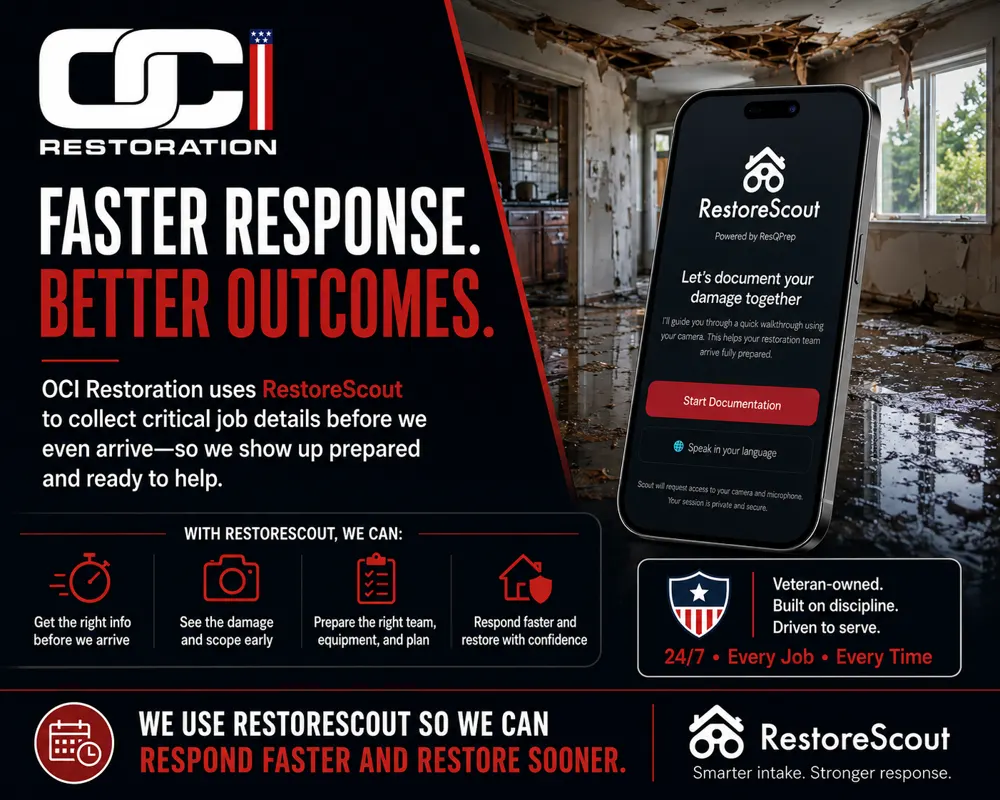
Document the damage before we arrive.
If you've found mold or a musty area after a leak, RestoreScout helps you photograph and describe it before anything is disturbed, so your carrier sees the original conditions.
What you capture goes straight to our team, so the crew arrives already knowing the scope, the access, and what equipment to bring — and your insurance file starts building from the first photo instead of the first visit.
- Takes a few minutes, whenever you're ready
- Nothing to download — it runs in your browser
- Available in your language
- Your session is private
Scout will ask for access to your camera and microphone. If you'd rather not use it, calling gets a team moving just as fast.
Frequently asked questions
Don't see your question? Call us anytime — real people, 24/7.
Does homeowners insurance cover mold?
Sometimes, depending on the cause. Mold that results from a sudden, covered water loss may be considered. Mold from long-term humidity, slow leaks, or maintenance issues is commonly excluded. Many policies also limit mold coverage in a separate section.
Is mold in a crawlspace covered?
Crawlspace mold in North Carolina is usually tied to long-term ground moisture and humidity, which policies commonly exclude. If it followed a specific event, like a burst pipe under the home, discuss that with your adjuster.
Should I clean the mold myself before the adjuster sees it?
No. Photograph it and leave it undisturbed until it has been documented. Disturbing growth can spread it and removes the evidence your adjuster needs to evaluate the claim.
Is mold dangerous to my family?
That's a question for your doctor. We focus on finding the moisture source and removing mold from the building. The EPA and CDC publish consumer guidance on mold.
What is post-remediation verification?
It is an inspection after remediation, and before rebuild, to confirm the work area has been cleaned and dried to clearance. It gives you and your carrier a documented end point for the mold work.
Related claim guides and services
Sources
Found mold after a leak? Document it first.
24/7 emergency mitigation and full restoration across the Triangle from our Raleigh office.
Important: OCI Restoration is a licensed restoration contractor, not a public adjuster, insurance agent, or insurance advisor. This page is general information about how property claims commonly work in North Carolina. Your policy language and your insurance carrier determine coverage. For questions about your specific policy, talk to your agent, your carrier, or a licensed public adjuster or attorney. The N.C. Department of Insurance Consumer Services Division can be reached at 855-408-1212.